What to Do Within 24 Hours of Water Damage in Maryland
The Clock Starts the Moment Water Enters Your Home
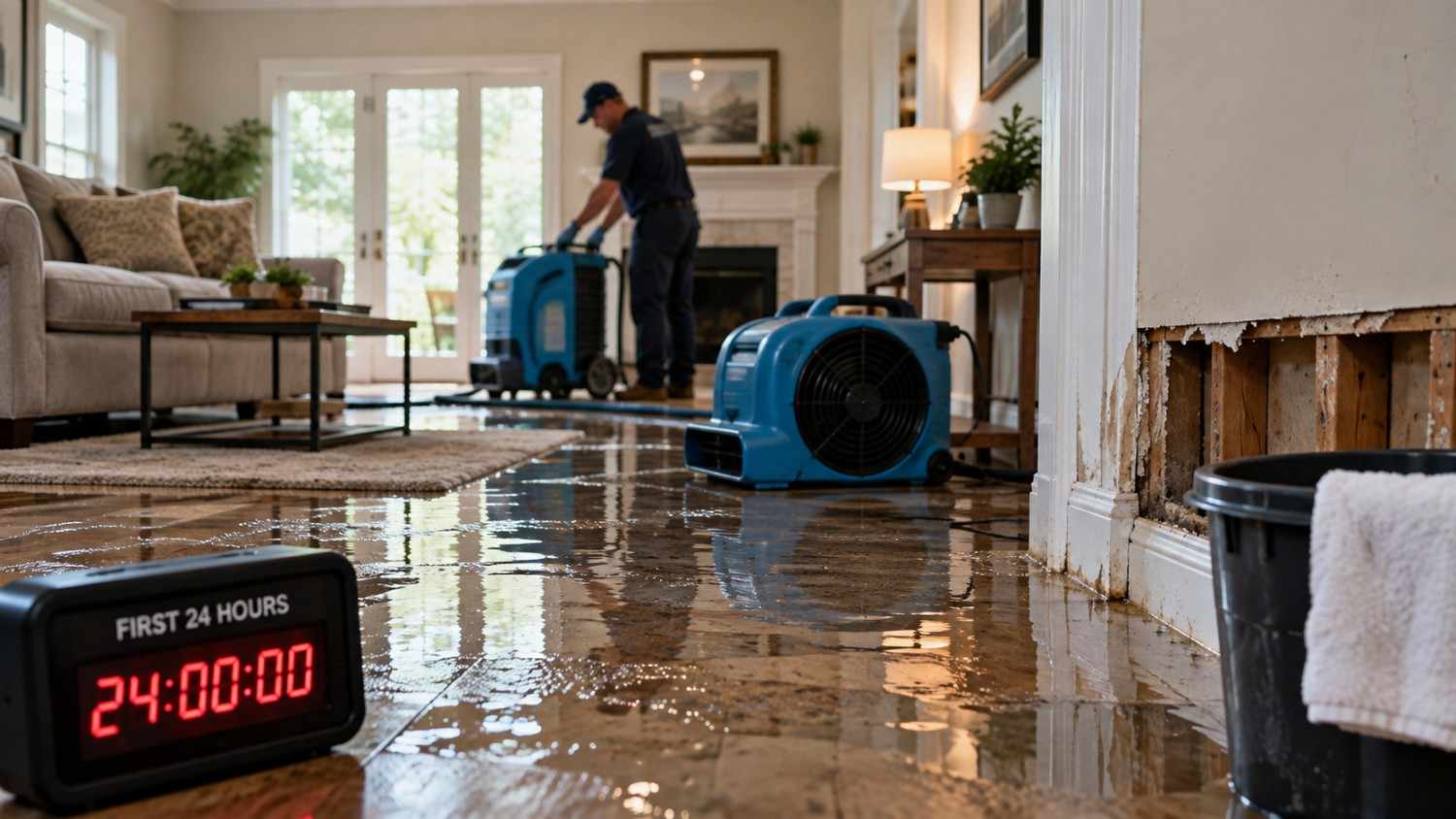
Most homeowners think water damage is about the water itself. It's not, it's about time. The difference between a $3,000 restoration job and a $30,000 one often comes down to what happened in the first 24 hours. After handling hundreds of water damage jobs across Central Maryland, our IICRC-certified team has seen exactly how fast things escalate when the right steps aren't taken quickly enough. This guide walks you through exactly what to do, hour by hour, from the moment you discover water damage in your home.
Water Damage Timeline: What Happens Hour by Hour
| Time Elapsed | What's Happening | Restoration Impact |
|---|---|---|
| 0–2 hours | Water spreads and begins absorbing into flooring, drywall, and furniture | Fastest, lowest-cost recovery window |
| 2–24 hours | Moisture wicks into walls, subfloor seams, and insulation; drywall and wood begin to swell | Professional extraction and drying required to prevent structural loss |
| 24–48 hours | Mold can begin colonizing damp materials; clean (Category 1) water can degrade toward Category 2 | Antimicrobial treatment becomes time-critical |
| 48–72 hours | Mold growth accelerates; untreated Category 2 water can progress toward Category 3 | Scope of work and cost typically expand significantly |
| 1 week+ | Structural materials may require removal and replacement; mold can spread through HVAC | Full reconstruction often becomes necessary |
Hour 1–2: Stop the Source and Stay Safe
Your first priority is stopping water from entering. If you're dealing with a burst pipe, locate your main water shut-off valve and turn it off immediately. In most Maryland homes, this is in the basement near the water meter or outside near the foundation. If you don't know where yours is, find it right now, before you ever need it.
If the source is a storm, sewage backup, or outside flooding, do not enter standing water more than a few inches deep. Floodwater can carry live electrical current from submerged outlets and appliances. Sewage backups contain dangerous pathogens that pose serious health risks. Your safety always comes first. Once the source is controlled, call RestoraMax immediately at (301) 357-8440. We dispatch 24/7 and arrive in 30–45 minutes anywhere in Central Maryland.
Hour 2–4: Document Everything Before You Touch Anything
Before you move a single piece of furniture or start any cleanup, document everything. Take photos and video of every affected area, floors, walls, ceilings, furniture, personal items, appliances. Open closet doors and capture those too. Pull back rugs and photograph underneath. Check adjacent rooms, because water travels much further than it appears on the surface.
This documentation is the foundation of your insurance claim. Your adjuster needs to see the damage exactly as you discovered it, not after cleanup has begun. Missing or incomplete documentation is the number one reason water damage claims get underpaid or denied. Your phone camera is your most valuable tool in the first two hours. Also make a written list of everything visibly damaged, furniture, electronics, flooring, appliances. Don't throw anything away yet.
Hour 4–8: Professional Water Extraction
Every hour that standing water sits in your home, it's doing more damage. Water doesn't just sit on surfaces, it wicks upward into drywall, travels along subfloor seams, soaks into insulation, and migrates to areas completely invisible to the eye. What looks like a contained area on your kitchen floor is often already saturating the wall cavity behind your cabinets. Professional water extraction uses industrial pumps and extractors capable of removing hundreds of gallons per hour, far beyond what any shop vac or consumer equipment can handle. When our team arrives, extraction begins immediately.
Important: Do not attempt to use a standard household vacuum to remove water. It's a serious electrical shock hazard and won't make a meaningful dent in the problem anyway.
Hour 8–16: Structural Drying and Dehumidification
Extraction removes standing water, but it doesn't dry your home. That requires commercial-grade air movers and dehumidifiers running continuously until professional moisture readings confirm every material has reached acceptable dryness levels. This is where most DIY attempts fail. Homeowners open windows, run box fans, and assume the job is done. It isn't.
Drywall, subfloor, framing, and insulation all hold moisture deep within their structure long after the surface feels dry to the touch. Our team takes baseline moisture readings when we arrive and tracks them throughout the drying process. Surface dry does not mean dry. Materials must reach specific moisture content levels, measured with professional equipment, before the drying phase is complete. Skipping this step is how water damage turns into a mold problem two weeks later.
Hour 16–24: Antimicrobial Treatment and Content Assessment
Mold can begin colonizing within 24–48 hours of water exposure under the right conditions. That's not a scare tactic; it's biology. Within the first 24 hours, RestoraMax applies antimicrobial treatment to all affected surfaces to stop mold before it starts. This step is non-negotiable on every job we run in Central Maryland.
We also begin a full content assessment, carefully cataloging every damaged belonging for insurance documentation. Furniture, clothing, electronics, personal items. Everything gets documented with photos and written descriptions. This protects your claim and ensures you're compensated for the full scope of your loss, not just the structural damage.
Water Damage Categories: Know What You're Dealing With
| Category | Source | Response Required |
|---|---|---|
| Category 1 – Clean water | Burst supply line, clean appliance overflow, broken ice maker line | Standard extraction and drying; degrades to Category 2 after ~24–48 hours if untreated |
| Category 2 – Gray water | Washing machine/dishwasher discharge, aquarium leaks, water sitting 24–48 hrs | Antimicrobial treatment, PPE, removal of saturated porous materials (e.g., carpet padding) |
| Category 3 – Black water | Sewage backup, floodwater, water sitting 72+ hours untreated | Full PPE, removal of contaminated porous materials, antimicrobial treatment, clearance testing |
What NOT To Do After Water Damage
Just as important as what to do is what to avoid:
- Don't use a household vacuum or shop vac to remove standing water; it's an electrical shock hazard.
- Don't turn on your HVAC system if ducts or air handlers may have been exposed to water; this spreads contaminants and mold spores throughout your home.
- Don't rip out drywall or flooring yourself; improper removal can spread contamination and actually harm your insurance claim.
- Don't wait to notify your insurance company; most policies require prompt notification, typically within 24–72 hours of discovery.
- Don't assume the damage is less serious than it looks. Water always travels further than the visible evidence suggests.
When to Call a Professional vs. Handling It Yourself
Here's the truth: for anything beyond a very small, contained spill that you've cleaned up within an hour, you should call a professional restoration company. The equipment required to properly extract water and dry a structure is commercial-grade and costs tens of thousands of dollars. The expertise to know where moisture is hiding- behind walls, under floors, inside cavities- takes years to develop. And the consequences of getting it wrong- mold, structural damage, a denied insurance claim- far outweigh the cost of professional restoration.
If you're in Central Maryland and dealing with water damage right now, call RestoraMax at (301) 357-8440. We answer 24/7, arrive in 30–45 minutes, and handle everything from extraction through full restoration, including your insurance claim documentation.
Related reading:
- Hidden Water Damage Signs You Might Be Missing
- Mold After Water Damage: What to Watch For
- Local vs. National Restoration Companies in Maryland
The Bottom Line
Water damage is a race against time. The faster you act, the less damage you face, the lower your restoration costs, and the smoother your insurance claim goes. Stop the source, document everything, call a professional immediately, and let the experts handle the rest. Your home, and your wallet, will thank you for moving fast.